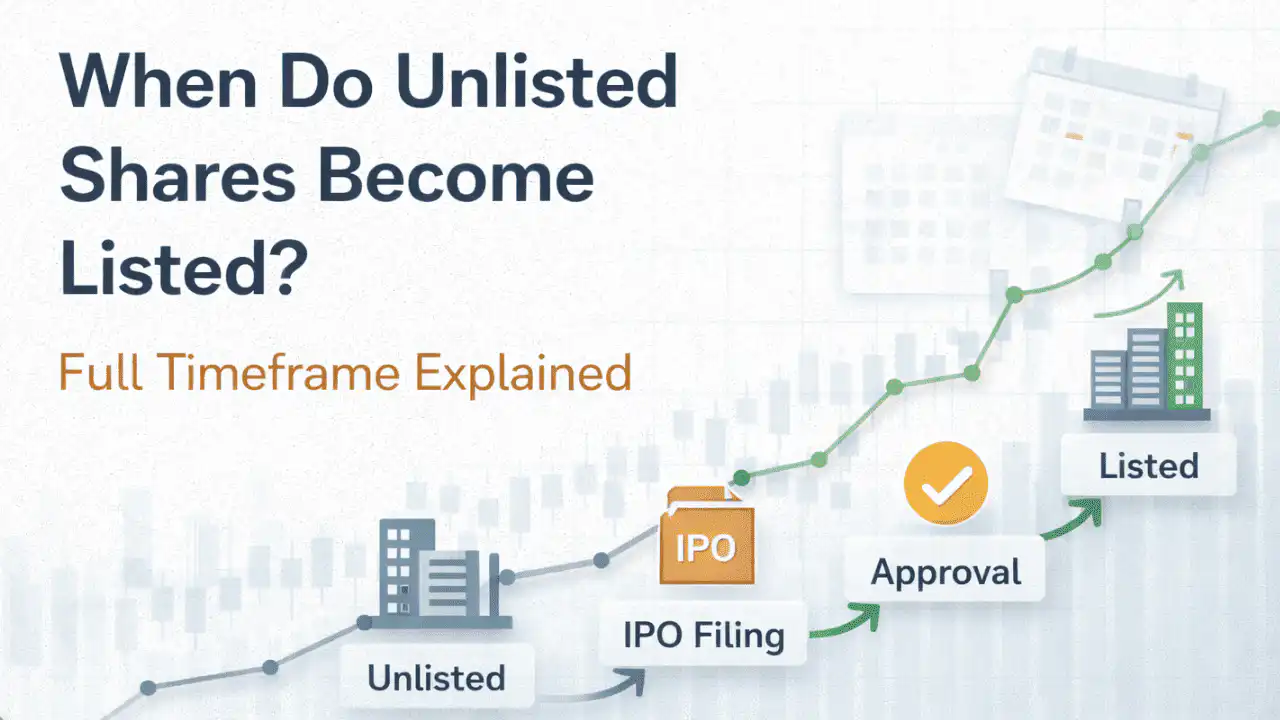
Most retail investors and institutional investors are interested in the unlisted shares of developing companies. However, one question appears to many investors is when do unlisted shares get listed? It is important to understand listing timelines of the shares and what to expect when these shares are going to get listed on the stock exchanges in India such as in order to make informed investment decisions.
This guide seeks to explain the entire listing process and the listing time of unlisted shares because of various factors as well as the journey from unlisted to listed shares. Investors may understand how long it will take for an IPO to occur and when unlisted shares become listed on stock exchanges.
What Are Unlisted Shares And Why Do They Matter?
Before determining when unlisted shares get listed on stock exchanges, it is important to understand the true definition of unlisted shares. Unlisted shares are the equity securities of companies that are not listed on any of the major stock exchanges such as NSE and BSE. These shares are often traded via private placements or OTC (Over-the-Counter) markets (Over-the-Counter) instead of being traded on centralized exchanges.
As companies grow, they are likely to engage in angel investing, venture capital, and private funding, and will likely avoid public listing in the immediate term. By learning about the companies’ unlisted to listed journeys as well as the timelines, investors can create and refine expectations in regard to the investment plan, and the unlisted shares who are going to be listed.
Why Do Companies List Themselves?
Understanding the motivation and reasoning behind a public listing helps investors to analyse when shares will be listed.
Access to Capital
An IPO provides funding to pay for expenditures in growth, research and development, modernization, or conversion of debt to equity. This is supported by the book building process of the IPO which facilitates price discovery and appropriate valuation.
Liquidity for Existing Shareholders
Listing shares provides the founders, employees with ESOPs, and early-stage investors the ability to cash out their shares.
Enhanced Credibility
A company that lists on a Stock Exchange demonstrates regulatory compliance with the SEBI and is likely to have higher standards of corporate governance and stakeholder trust.
Market Valuation
Public market valuation differs from private market valuation. In the case of unlisted shares, market demand and supply play a major role in deciding for unlisted share valuation.
Compliance and Governance Structure
When a company gets listed, it adheres with the proper structuring of corporate governance systems and SEBI guidelines. This, in turn, improves organizational compliance and discipline within unlisted share companies who want to list on the stock exchanges.
The Comprehensive Timeline: From Unlisted Shares to Listed Shares
The process of becoming listed can take several years and occur in various stages. Unlisted shares are initially transformed to become listed by a series of events which can be explained in the following stages.
Stage 1: Pre-IPO Preparation (12-24 Months)
This is one of the most important phases of a listing in a company’s timeline.
- Financial Audits and Restructuring: Companies optimize historical financial records to meet the expectations of regulatory bodies.
- Corporate Governance Improvements: The employment of independent directors as well as the formation of audit committees and internal systems is accomplished.
- Business Validation: The company is required to prove sustainable revenues and a company’s ability to scale.
- Legal Readiness: The company resolves all old disputes, IP issues, and compliance deficiencies.
Over the course of 12-24 months, this phase takes a company to undergo complex restructuring.
Stage 2: Engaging Advisors and Bankers (3-6 Months)
Once the intent to become listed becomes definitive:
- Investment bankers determine the IPO size as well as give valuation and book-building structure.
- Legal advisors draft all necessary documentation and guide the company through the process of adhering to all regulatory requirements.
- Auditors give a thumbs up to the financial disclosures.
- The team in charge of the company’s public relations outlines and formalizes a communication strategy to the investors.
Overlapping periods of the prep and advisory phases span an average of 3-6 months.
Stage 3: Filing with SEBI and Approval (4-6 Months)
The SEBI phase is one of the most important to determine the date of unlisted shares listing.
Submission of Draft Red Herring Prospectus (DRHP)
SEBI reviews and addresses any clarifications
Comments from the Public
Final Regulatory Approval
This step takes on average 4 to 6 months, but can take longer for more regulated industries.
Stage 4: Investor Roadmap and Marketing (2 to 4 weeks)
Companies start to do their outreach:
- Institutional investor meetings
- Retail investor awareness
- IPO price band finalization
This takes 2 to 4 weeks on average before the subscription window opens.
Stage 5: IPO Subscription Window (3 to 5 days)
In this window investors will bid for shares within the price band that has been set.
This is a period of demand and subscription levels for different investor categories.
Stage 6: Allotment and Listing (7 to 10 days)
When basis of allotment is final
- Unsuccessful applicants are refunded.
- Demat accounts are credited.
- Trading begins on listing day.
This is usually how the final span is completed in 7 to 10 working days.
Real-World Case Studies: From Unlisted to the Path of Listing
Zepto: Unlisted Share company
Zepto transitioned quickly from a starting point in quick commerce to a high visibility company with strong revenue growth. Building governance, operational discipline, and unit economic improvements means companies often spend prep time before pursuing a listing pathway. The journey shows that the fundamentals of market readiness, financial stability, and compliance groundwork significantly determine the character of the shift from unlisted to listed.
OYO: Unlisted Share Company
OYO wanted to go through with an IPO plan, but faced revisions and postponements when the market sentiment changed. The company renewed operational optimizations and disclosure refreshed aligned timing, showing that timelines extend on even popular names in the market to match the valuation, regulatory, and macro state of the market. However till now, OYO’s journey clearly outlines the expectancy of the timeline to list, patience, the regulatory journey, and most importantly the control on the expectations.
Total Timeline: How Long Does It Take?
Taking into consideration all the stages of unlisted shares getting listed, unlisted shares typically take 18-36 months to be listed starting from the initial decision to the actual listing day.
Having an understanding of the unlisted shares listing timeline in India is important for investors, as it provides answers to the question, when will unlisted shares be listed on stock exchanges?
This information helps investors to adjust their expectations and devise an investment strategy for unlisted shares before the listing.
Factors Influencing When Unlisted Shares Get Listed
The listing process can be influenced by any number of factors. In turn, these elements can help determine when unlisted shares become listed.
Market Trends
Bull markets tend to have more positive sentiment and therefore promote more public listings, while bear markets have the opposite effect. Thus, market conditions can dictate the time in which unlisted shares can be listed.
Change in Rules, Policies and Regulations
The addition of any new SEBI rules, the addition of new requirements for disclosure, and changes of any SEBI policies can create a more complex SEBI approval process. This can lengthen the time unlisted shares can become listed.
Company Size
Companies that are larger, have more divisions, and have a complex ownership structure tend to require more due diligence. The more the due diligence is, the more it will negatively impact the listing timeline.
Industry-Specific Regulations
The insurance, banking, and pharmaceutical industries are often subject to more oversight than others, as their industries tend to require them to obtain more regulatory approvals.
Financial Stability
The presence of consistent revenue, positive financial audits and strong profitability streamline most approvals and increases the chances of unlisted shares being listed.
Promoter Readiness
Promoter shares that are held by the owners of the company are the most important shares to be sold in a public offering. Investors need to assess the timeline of unlisted shares becoming listed to understand the factors that influence when unlisted shares get listed.
Different Listing Avenues: Alternative Routes for Unlisted Shares to Get Listed
Not all companies take the traditional IPO route. When companies take different approaches, the unlisted shares can get listed through various means.
Direct Listing
New capital is not needed for companies that will do a direct listing. This method tends to be a little more time-consuming because it can take from 6 – 12 months.
It offers a relatively quicker way to determine when unlisted shares will officially be listed.
Reverse Merger
Unlisted share companies can take the route of joining other unlisted share companies that have merged with a shell company that is already listed. This method is also a little quicker, taking about 6 – 9 months to complete the process. However, the popularity of this method has decreased due to the changes in the regulatory method of listing unlisted shares.
SPAC Route
Mergers with Special Purpose Acquisition Companies (SPAC) have been a new method to take, but in India, it is still in a primary developing stage due to the overlapping SEBI guidelines. Every scenario will impact both the time it will take to list unlisted shares and the time until unlisted shares finally get listings.
Indicators That Unlisted Shares Are Expected to List Soon
There are common indicators that tell unlisted shares are expected to list soon and provide insight on how to track unlisted shares which are going to be listed:
Appointment of investment bankers: The majority of the time when companies engage very top-tier investment bankers, it suggests that listing is going to happen and insights on how soon unlisted shares will list.
DRHP filing with SEBI: Once a company files a DRHP, investors can track companies preparing for IPO and stay informed about likely listing timelines.
This is based on the average time on the DRHP filing to listing time continuum.
Increased financial press coverage: More media coverage, along with management interviews, and public statements describing the company’s growth, are believed to be other indicators of the company’s listing intentions.
Recruitment of key compliance executives: It’s quite common for companies to hire CFOs, compliance officers, and investor relations officers, during the same timeframe in pre-IPO preparation for life in the public market.
Consistent Revenue Growth: The company’s quarter on quarter sustained increases in revenue and profit margins show the company is gearing up for the public market. This is likely to be indicative of the company subjecting itself to a more rigorous financial audit scrutiny.
Expansion of ESOP frameworks: An expansion of ESOP is likely to be imminent when a company is trying to establish frameworks so that employees will be able to purchase shares of the company at market values.
This indicates that companies are often preparing for listing.
These benchmarks aid investors in comprehending when unlisted shares will be listed and facilitate monitoring of the journey toward listing day.
What Happens to Unlisted Shares After They Get Listed?
Investors must consider the consequences of what happens to unlisted shares when they get listed.
The Process of Share Conversion
Your unlisted shares will be converted to listed shares via the unlisted to listed shares conversion process, which is typically done on a 1:1 basis. On listing day, companies may, however, do a stock split or a bonus issue.
Dematerialized Accounts
Listed shares must be kept in a dematerialized form in your demat account. To facilitate a smooth share conversion process, ensure that your unlisted shares are in demat mode before the listing.
Lock-in Periods
Investors will be subjected to a lock-in period for unlisted shares after listing that ranges between 6 months and 3 years, depending on the timing of the acquisition and investor category. Pre-IPO investor shares have shorter lock-in periods than promoter shares.
Trading Flexibility
After listing, and after the applicable lock-in periods have expired, you will have the flexibility to sell shares on the NSE or BSE whenever the Market is open.
Price Discovery
The process of price discovery, which is used by public markets to determine the fair price of shares, can vary widely from the valuation of unlisted shares prior to listing on Over-The-Counter markets or the subsequent price band for an IPO.
Tracking Listing Progress: How to Track When Unlisted Shares Become Available for Purchase
To remain updated and track when unlisted shares become available for purchase, you can try the following methods.
Monitoring the SEBI Site: Look for updates on the SEBI site, including the status of the DRHP, the status of the queries, and updates from SEBI regarding approvals, as these may relate to the progress of the listing timeframe.
Corporate Announcements: Monitor corporate announcements, press releases, and social media for updates regarding their intended listings and from the various stages of unlisted shares getting listed.
Business News Channels: Track the business news that reports on the IPOs, the state of the markets, and anticipated timelines for IPOs to monitor the timing of the listings of the unlisted shares.
Updates from Brokers: Brokers that deal in unlisted shares often provide updates on the listing progress, timelines from DRHP filing to listing, and developments in the markets.
If you are interested in getting current insights regarding the unlisted share market, you may explore timely updates on upcoming IPO listings and unlisted share developments.
Announcements from the Stock Exchanges (BSE/NSE): The National Stock Exchange and the Bombay Stock Exchange provide announcements on their websites regarding upcoming IPO listing and subscription dates.
These tracking methods build the groundwork for a successful strategy where unlisted shares become investor roadmaps for listing. Optimizing Investment Strategy Before Listing Strategies for investment in unlisted shares before listing should address the following:
Diversification Balance
Investing in unlisted shares should not be the only option. Have a more balanced unlisted share investor roadmap before listing that includes liquid equity securities and other asset classes.
Thorough Research
Before purchasing unlisted shares, research the business model, financial position, competition, and management of the company to have a full understanding of the realistic scenarios. Do detailed company research on unlisted shares to better assess potential listing outcomes for more information you can visit delisted stocks
Valuation Benchmarking
Evaluate the Over-The-Counter markets to determine the company values in comparison with other competing companies in order to assess whether unlisted shares have a fair valuation before listing.
Market Awareness
Be aware of the market conditions, whether it is in a bull or bear phase, and the regulations and news on unlisted shares to be aware of how it can affect when unlisted shares get listed on a stock exchange.
Conclusion
The process of unlisted shares becoming publicly listed involves multiple stages, each impacting the overall timeline of the Initial Public Offering (IPO), which ranges from 18 to 36 months. Investors should exercise patience, considering the timelines from the process of governance upgrades, SEBI approvals, market readiness to the investors, and each improving disclosure. Reasonable timelines should be anchored on indicators such as the Draft Red Herring Prospectus (DRHP), the company’s disclosure and overall performance.
When shares are listed, they undergo conversion, lock-in agreements are instituted, and the process of price discovery begins. Based on these stages of the share listing process, time should be viewed as a strategic opportunity rather than a period of uncertainty. To stay updated on unlisted share listings in India and track upcoming IPO developments, explore stay updated on unlisted share listings in India.
FAQ’s
Q1-What are unlisted shares?
Q2-How long does it usually take for unlisted shares to get listed?
Q3-Why do companies decide to list on the stock exchange?
Q4-What are the major stages in the listing journey?
Pre-IPO restructuring
Hiring advisors and investment bankers
Filing and approvals
Marketing and roadshows
IPO subscription
Allotment and listing on the exchange
Each stage has its own timeline and compliance requirements.
Q5-Does SEBI approval decide when unlisted shares get listed?
Q6-What factors can delay the listing of unlisted shares?
Q7-Are there other methods for unlisted shares to be listed?
Q8-What happens to my unlisted shares once the company lists?
Q9-How can I track whether unlisted shares are moving toward listing?
Disclaimer
This article is for informational purposes only and should not be considered investment advice. Prices and data of unlisted shares are based on publicly available sources and may vary. Investors are advised to conduct independent research or consult financial professionals before making investment decisions.