Table of Contents
1. The Headline: PharmEasy’s EBITDA Turns Positive for the First Time
2. Q3 FY26 Consolidated Numbers at a Glance
3. Segment-by-Segment Breakdown
4. Thyrocare: The Profitable Engine Driving the Group
5. What This Means for PharmEasy Unlisted Share Price
6. The Road to Full Profitability: FY27 and Beyond
7. Should You Buy PharmEasy Unlisted Shares Now?
The Headline: Pharmaeasy’s Ebitda Turns Positive for the First Time
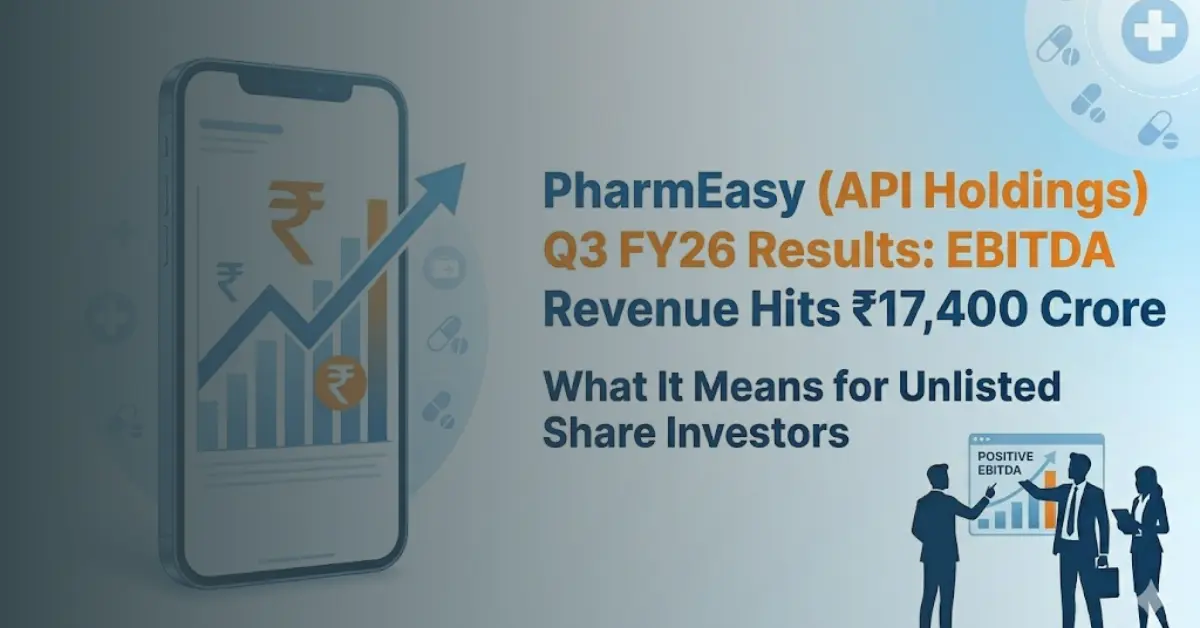
Investors in API Holdings (PharmEasy) can finally relish a positive EBITDA after years of losses and further painful valuations. The data in the investor presentation for the company for Q3 FY26 is demonstrating a historic shift. There was a Positive EBITDA for the first three quarters of FY26 (April – December 2025) of ₹292Mn. This is a stark contrast to the EBITDA loss of ₹2,311Mn from the same duration in the previous year. This is an improvement of over ₹2,600 Mn, with strong revenue growth and aggressive operational cost reduction across all business units. For investors in the pre-IPO market who track the PharmEasy unlisted share price, this is undoubtedly the most favorable development for the company since the company’s after valuations from a peak of $5.6 Billion.
(source: https://www.apiholdings.in/_files/ugd/7760e6_5126609ac74741ba888e27bd88bca6bb.pdf)
Q3 FY26 Consolidated Numbers at a Glance
| Metric | Value (FY26) | Comparison / Change |
| Revenue (Q3 FY26) | INR 17,400 Million | – |
| Revenue (9M FY26) | INR 50,955 Million | +14.7% YoY |
| Gross Profit (9M FY26) | INR 9,903 Million | +20.6% YoY |
| Gross Profit Margin (%) | 19.4% | Up from 18.5% |
| Operating Costs (9M FY26) | INR 9,554 Million | -1.4% YoY |
| EBITDA (9M FY26) | INR 292 Million (Profit) | Improved from INR 1,482 Million Loss |
| EBITDA Margin (%) | +0.6% | Up from -3.3% |
| PBT (9M FY26) | -INR 3,509 Million (Loss) | Loss reduced by 38% from -INR 5,657 Million |
(Source: https://www.apiholdings.in/_files/ugd/7760e6_5126609ac74741ba888e27bd88bca6bb.pdf)
The results indicate that revenue is up, gross margins are up, and operating costs are down, with the firm approaching the break-even point in real terms. It is also worth noting that a decreased number of days of operating working capital is a sign of improved operational discipline.
SEGMENT-BY-SEGMENT BREAKDOWN
B2B (Pharma Distribution: Ascent)
The B2B segment (Pharmaceutical Distribution to merchant chemists) reported gross revenue of INR 30,432 Million for 9M FY26, up 16.3% from the prior year. The reported loss before interest, taxes, depreciation, and amortization actually improved to a loss of INR 156 Million (from a 9M FY25 loss of INR 615 Million). The B2B segment actually achieved an EBITDA profit of INR 38 Million in the FY26 Q3 period for the first time, making the segment the group’s largest former loss component.
B2C (PharmEasy Consumer Platform)
Revenue from the consumer app over the first nine months of F.Y. 2026 Pe stood at ₹9,830 Mn, up 18% from the previous F.Y. Gross margins expanded to 25.2% (from 22.7%), thanks to improved product mix and a reduction in promotion costs. In terms of the trajectory, the narrower EBITDA loss of ₹342 Mn (from ₹469 Mn) is expected to result in a breakeven.
Aknamed (Hospital Supply)
Revenue from the hospital supply division modestly declined to ₹5,046 Mn, a 3.9% decrease over the first nine months of F.Y. 2026. More notable is the effective elimination of losses, with EBITDA almost breakeven, improved from nearly ₹817 Mn to nearly ₹55 Mn, a 93.3% improvement. A marked improvement in previous years of loss from credit under the exceptional basis was the main factor underwriting the loss.
(Source :https://www.apiholdings.in/_files/ugd/7760e6_5126609ac74741ba888e27bd88bca6bb.pdf )
Thyrocare: the Profitable Engine Driving the Group
Thyrocare, the listed subsidiary of API Holdings in the diagnostics sphere, remains the most valuable asset in the group. Costing the least to hold, and generating the most positive cash flows, it is illuminating its comparative performance vis-à-vis the group.
For the first nine months of F.Y. 2026, Thyrocare’s performance included the following:
- Revenue: ₹6,051 Mn (21.1% YoY increase)
- Gross Margin: ₹4,422 Mn (73.1%, up from 71.7%)
- EBITDA: ₹2,010 Mn (38.9% YoY increase)
- EBITDA Margin: 33.2%
Thyrocare’s results in the diagnostics market are unrivaled. Positive cash flows from Thyrocare (subsidiary) fully underwrite the group’s continued investments into the B2B and B2C, while the unprofitable part of the group approaches profitability.
(source: https://www.apiholdings.in/_files/ugd/7760e6_5126609ac74741ba888e27bd88bca6bb.pdf)
Impact on Pharmaeasy’s Unlisted Share Price
The unlisted market for PharmEasy stock is set to change. EBITDA results for the consumer app represent a break from the market’s previous negativity with the greatest level of conviction against. The unlisted market case was that the company was unable to control costs. From Q3 FY26, that narrative is almost certainly set to change. Users checking the unlisted stock market on platforms such as Delisted Stocks are able to see the increasing interest in PharmEasy shares. Top line growth due to a 14.7% increase in revenue, margin growth, and the first historic EBITDA shift are signs to the pre- IPO investors that they are wise to think there will be a re-rating. For reference, API Holdings’ closest competitor in the healthcare-tech listed space, Thyrocare, trades at a meaningful EBITDA multiple premium valuation post profitability. As such, if API Holdings continues to remain on the path they are towards positive EBITDA, the current unlisted valuation will start to look justified. For investors interested in the MSEI unlisted share prices and other pre- IPO share offerings, PharmEasy will be useful for comparison for the unlisted share market.
The Road to Full Profitability: Fy27 and Beyond
The company may look at this as a major victory, however, the company remains loss making before tax due to financial costs of ₹3,402 for 9M FY26, although a decline of 13.8% was a year on year decline. The company’s loss before tax of ₹3,509 for 9M FY26 indicates the company remains in the early innings to achieve net profitability. The path they are on, financial costs are falling as they continue to restructure debt, opex discipline remains, and the gross margins are growing for the company each quarter. For more research on the net profitability of PharmEasy, check out our overview of PharmEasy unlisted stocks and the FY27 profitability framework.
Should You Buy Pharmeasy Unlisted Shares Now?
Q3 FY26 results and, FY26 for that matter, represent a structural change vs. a one-quarter blip. Revenue growth is broad-based, with structural margin improvements, and there’s evidence of EBITDA change over Q2 FY26, Q3 FY26, and Q4 FY26. Risks still remain a debt burden and the timeline with regard to net profitability. This may be an entry point for prospective investors with horizons of say 2-3 years and with an appetite for liquidity risk. Take this opportunity to invest in the shares in advance of Spirit Airlines, a potential IPO, or perhaps further valuation moves. Treat it as an unlisted trade, as always, via a registered and verified trade only and with full KYC. Preferably, engage a SEBI advisor, as always. In the interim, to view the share price for NSE unlisted shares.
Frequently Asked Questions
Q1-What does the positive EBITDA in Q3 FY26 indicate for PharmEasy (API Holdings)?
Q2-How strong is PharmEasy’s revenue growth in FY26 so far?
Q3-Which business segment is contributing the most to profitability?
Q4-Is PharmEasy fully profitable now after this EBITDA turnaround?
Q5-How are PharmEasy’s individual business segments performing?
The B2C platform units have shown fewer losses and stronger margins. Hospital Supply units have shown fewer losses as well. All units of the business are improving with operational profit and profitability.
Q6-What does this performance mean for PharmEasy unlisted share price trends?
Q7-What are the key risks investors should consider?
Q8-What is the expected outlook for PharmEasy in FY27 and beyond?
Disclaimer
This article is for informational purposes only and should not be considered investment advice. Prices and data of unlisted shares are based on publicly available sources and may vary. Investors are advised to conduct independent research or consult financial professionals before making investment decisions.