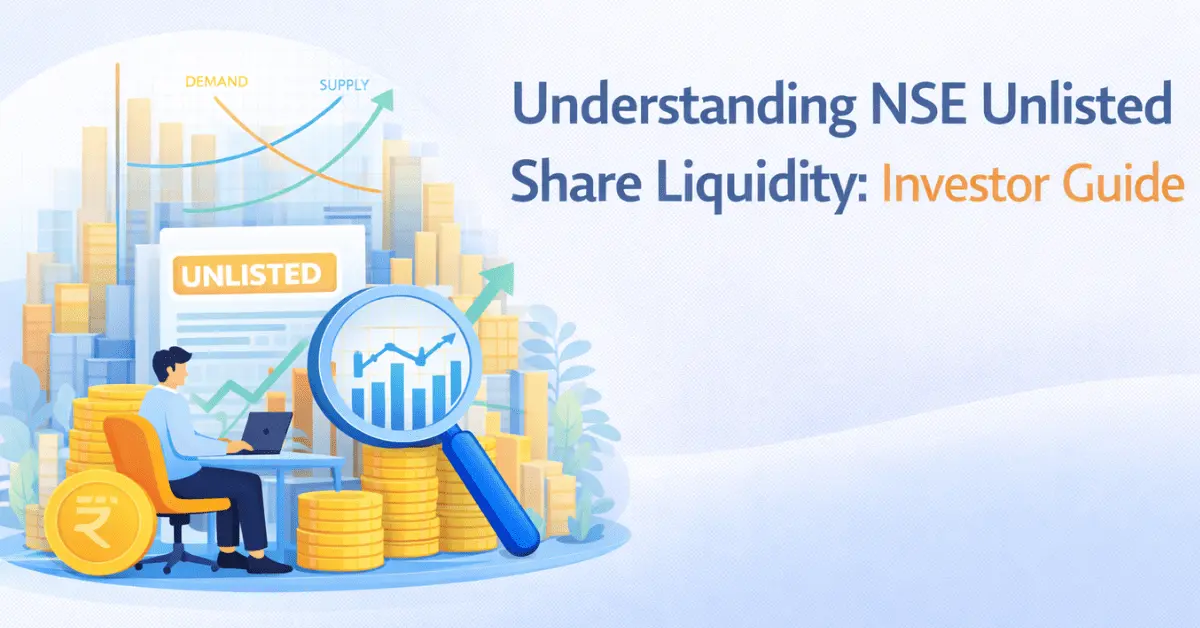
Consider a scenario where you have a one-million-rupee painting. While it seems great to have a painting worth that much, that asset still needs to have buyers. If we keep the painting in a hypothetical scenario where buyers do not exist, we would be facing an issue of a liquid asset that cannot be converted to cash, despite still owning it. The same rationale applies to NSE unlisted shares. If an unlisted share lacks liquidity, one cannot buy or sell the share without weeks or months of waiting, or having to sell at absolute rock bottom prices. The query related to liquidity in the NSE unlisted shares market is directly proportional to how quickly an investor can find buyers or sellers at a given market rate to eliminate any gaps in the market. In this guide, we have included all information regarding liquidity concerning NSE unlisted shares in the simplest language possible. Unsure of what unlisted shares are? Visit Delisted Stocks and get correct insights regarding the unlisted share market, and start your journey in the unlisted share space.
What Exactly Is Liquidity?
Let’s keep it simple and start with the basics. Obscure and complex explanations are not needed to establish a foundational understanding of liquidity. What does liquidity in NSE unlisted shares mean?
1. Simplicity of Trade
When it comes to trading, will it take you weeks to find someone, or does it happen in a snap?
2. Presence of Counterparties
When you want to sell, are there buyers? When you want to buy, are there sellers?
3. Transaction Time
How instantaneous is the deal from agreement to transfer of ownership?
4. Price Consistency
During negotiations, does the price have a consistent band or does it fluctuate so wildly or not? An example: It is easy to sell gold at fair market value. It is hard to sell a rare antique because the market is illiquid. NSE unlisted shares are hot in demand, but the level of demand is variable in different market situations.
How Is Liquidity Different in Unlisted vs Listed Shares?
This is crucial in understanding how unlisted and listed markets operate.
Listed Shares (Ordinary Stocks):
- Negotiable on stock market exchanges (NSE or BSE).
- Trading prices change every second during the trading day.
- Sell/buy orders can be executed on your trading application.
- High buyer/seller (in the order of several hundred thousand).
- Demonstrate the level of supply and demand.
Unlisted Shares (Similar to NSE Unlisted shares):
- Negotiable off the market.
- Price negotiation between buyer and seller.
- Average time to complete a transaction = several days.
- High or low centered around the market demand.
- No public order book (trade discreetly).
The main distinction is that, in public markets, daily trading volume determines liquid assets, but, in private markets, liquid assets are determined by market demand, transaction volume, and supply and demand equilibrium.
NSE unlisted shares with high liquidity offer:
- Quicker trades
- Improved price determination
- Better allocation of resources
Why NSE Unlisted Shares Are Special
Let’s first examine why NSE unlisted shares have liquidity. The National Stock Exchange of India (NSE):
- Has the highest stock exchange trading volume in India.
- Supports the majority of India’s equity and derivatives trading.
- It is a major player in the country’s financial services industry.
- Is a technological innovator in financial market infrastructure.
- High market demand draws attention to NSE and similar institutions.
To grasp the larger context, go through this guide on Stock Exchanges in India and their Economic Significance. As awareness in the market increases, the participation in opportunities linked with the exchange increases. This has a direct impact on the liquidity of the unlisted shares of the NSE.
Key Drivers That Affect NSE Unlisted Share Liquidity
Now, let’s look at what exactly drives liquidity in NSE unlisted shares. These are the characteristics that will determine whether it will be easy or difficult for you to buy and sell unlisted shares.
1. The Overall Level of Activity in the Market
This is the greatest driver of liquidity. When stock markets are active (bull markets):
- More people are interested in investing.
- Capital flows freely.
- High trading volume.
- Increased investor confidence.
- Increased exploration of investment opportunities beyond stocks.
During such times, there is a significant improvement in the liquidity of unlisted shares of the NSE due to:
- The market increases the number of opportunity-seeking buyers.
- The market improves the conditions for selling for each holder in the market.
- The market increases the trading and selling of shares.
- The market increases the demand for unlisted shares.
It’s simple: When a restaurant is full, people go to the new restaurant next door. When the market is active, people buy unlisted shares.
Want to understand this connection better? Read our detailed analysis on Why Demand For Unlisted Shares Increases During Active Market.
2. Demand and Supply
Liquidity is essentially the equilibrium between buyers and sellers.
High Liquidity Scenario:
- Many buyers are interested
- Many sellers are interested
- High agreement across buyers and sellers
- Rapid deal closing
Low Liquidity Scenario:
- Buyers show little interest
- Sellers show little interest
- Long negotiations
- No deals or slow deals
For NSE unlisted shares, the demand-supply balance is influenced by:
- General market conditions
- Previous transaction history
- News on upcoming NSE IPOs
- Financial health of NSE
Seller confidence is boosted by increased buyer inquiries. More active sellers mean more transactions. This balanced participation means transaction flow gets better and better for NSE unlisted shares.
3. Information Flow and Transparency
The general market perception improves the more available and clear the information is.
When the market is active:
- More discussion surrounding specific data at the exchange level
- Market trading results are more visible
- More institutional investors
- More media coverage
- More general understanding
When the available information improves, the buyers:
- Become more confident
- Understand the market conditions better
- Align on price expectations
- Reduced uncertainty
Understanding the correlation between trading activity and the NSE unlisted share prices improves with better information. When trading activity improves, so does the liquidity of the NSE unlisted shares.
4. Transaction Process Efficiency
The actual transaction process also affects liquidity.
The components of a transaction of shares that are not listed include:
- Buyer and seller price agreement.
- Compliance and documentation.
- Share transfer through either CDSL or NSDL.
- Settlement of payment.
- Final confirmation.
The following are a result of a good working flow of a process that is straightforward for all parties involved:
- These transactions are completed in a shorter time.
- Confidence in the counterparty is increased.
- There is an increase in the likelihood of repeat participation.
- Strengthened liquidity.
Are you stuck on how to go about the process? You have an option for step-by-step processes that explain in detail how to go about the purchase and transfer of unlisted shares. The more structured and efficient the process is, the more liquidity it will contribute to unlisted shares at the NSE.
How Liquidity Benefits Both Buyers and Sellers
The unlisted shares’ NSE liquidity is good, and it is obvious that it is good for all parties involved, not just one side.
Benefits for Buyers:
- Rapid execution — No need to wait weeks to finalize a purchase.
- Reduced spreads — Smaller differences between bid and ask prices.
- Improved clarity — Understand pricing.
- Increased assurance — Ability to exit the position later.
Benefits for Sellers:
Increased inquiries — More potential buyers reach out to you.
- Increased competition — Buyers push prices up due to competition.
- Better pricing — Prices based on market valuations.
- Quick access to cash — Convert shares to cash easily.
- More options — Ability to sell at your discretion.
When supported by ongoing marketplace activity, liquidity results in a positive outcome for all participants.
Understanding Liquidity Cycles
An essential point to understand, liquidity for unlisted shares at NSE is cyclical, not static. It follows the broader marketplace conditions.
When Active Market Phases (Bull Markets) occur:
- There is a greater volume of queries due to increased interest in NSE shares.
- Transaction closures occur faster, taking days.
- Participation increases for both buyers and sellers.
- There is improved price negotiation, making it easier to reach an agreement.
Overall, there is better liquidity.
When Quiet Market Phases (Bear Markets) occur:
- There is a reduced volume of queries due to decreased interest.
- Transaction closures occur more slowly, taking weeks.
- Participation is selective, creating a lack of interest from buyers and sellers.
- There are wider negotiation gaps, making it more difficult to reach a price agreement.
There is a lack of liquidity. Active phases improve the liquidity of unlisted NSE shares, creating better market conditions overall. This explains the importance of timing in market activity when buying or selling. Institutional investor confidence plays a large, but even an indirect, role in liquidity. This includes investing institutions such as mutual funds, insurance companies, and foreign investors.
When institutions engage with listed markets:
- All market indicators show positivity
- Volume increases
- Interest increases
This positivity generated by NSE extends to unlisted shares, easy investments, and traceable investments that become unlisted to NSE shares. Let’s put it this way: Big players show confidence in India’s markets → Everyone else follows → NSE, as the backbone of the markets, captures this confidence.
Visibility and Market Confidence Connection
When confidence rises, liquidity improves. Here’s the process:
Increased confidence in the market leads to:
- More talk about the market and the infrastructure
- More interest in the unlisted opportunities
- Increased inquiries about NSE shares
- More buyers
- More sellers
This Starts a Virtuous Cycle
Impenetrable confidence → Extreme awareness → Increased inquiries → Improved liquidity → More trades → Confidence
The cycle of participation that sustains the liquidity of NSE unlisted shares.
Comparing NSE Liquidity with Other Exchange-Linked Shares
Differing liquidity levels exist in unlisted shares. Let’s explain the differences. Unlisted shares linked to exchanges such as NSE, MSEI, and BSE attract attention due to their fundamental role in the capital market.
However, the levels of liquidity vary due to:
- Brand recognition – NSE is more known as compared to smaller exchanges
- Market dominance – NSE has a greater than 90% market share of the derivatives market
- Depth of participation – more people are aware of NSE
- Frequency of inquiry – NSE shares receive more inquiries
- Volume of transactions – more transactions are made for names that are more popular
With respect to smaller exchange-related unlisted shares, NSE has greater dominance and visibility, hence, greater liquidity. To get more details about specific shares and their current prices, please visit the NSE unlisted share page.
How Market Sentiment Affects Liquidity
Market Sentiment:
Positive sentiment- when investors are optimistic:
- They are willing to trade
- Deals are made, and transactions are completed
- Market demand is created
- All of the above result in the enhancement of liquidity
- Prices may remain the same, or may increase
Negative sentiment- when investors are pessimistic:
- No new market commitments
- Deals and transactions are delayed
- Demand is reduced
- All of the above result in a reduction of liquidity
- Prices may decrease
Positive market sentiment increases the liquidity of unlisted shares of NSE and enhances the responsiveness and efficiency of the market. This is how market mood matters: Even when fundamentals are strong, negative market sentiment can lead to a short-term decrease in market liquidity.
Factors That Strengthen NSE Unlisted Share Liquidity
Let us summarize the most important drivers of strong liquidity.
Market-Level Determinants
- Increased volumes of trades in the NSE
- Increased retail participation in the market
- Activity of institutions in the market
- Consistent regulations
- Financial literacy of the investors
Share-Level Determinants
- Active inquiry of NSE shares
- Recent successful trades
- Pricing references
- Good news regarding NSE
- Expectations and speculation regarding IPO
Process-Level Determinants
- Efficient processes of transactions
- Trustworthy market intermediaries
- Simple and clear processes
- Quick settlement processes
These factors combine to facilitate positive liquidity for the NSE unlisted shares.
Why Liquidity Matters Before You Buy or Sell
When making investment decisions, liquidity is of great importance and is making itself known for the following reasons:
When liquidity is high on NSE Unlisted Shares, it means:
- Easier Entry: You can buy at a moment’s notice when there is an opportunity
- Smoother Exits: You can sell at any given time when there is a need.
- Reduced Waiting Period: You do not have to wait weeks for the transaction to go through.
- Transaction Efficiency: The deals will close without any issues.
- Fair Pricing: Prices are determined and set by the market, not by a desperate buyer or seller.
- Flexibility: You have the freedom to choose the time of the transaction when it needs to be done.
In a ‘low liquidity’ position, it can become very difficult to buy or sell the given share at a given time. In a low liquidity position, it can become very difficult to buy or sell a share in a short amount of time. When there are emergencies with buyers, they will be forced to sell the share for much lower than its market value. This will also limit the buyer’s negotiating power.
As an example, if you are in need of money urgently, NSE unlisted share liquidity allows you to sell the share within a matter of days. This is clearly not the case when the liquidity is low, and it will take you weeks to do so, or you will have to sell it for a lot less than the share is worth. When the liquidity in NSE unlisted shares improves, it allows for better planning when it comes to buying or selling the shares in the future. This holds true regarding liquidity in NSE unlisted shares for the future, after today’s date.
Long-Term Perspective on Liquidity Trends
India’s capital markets have shown:
- Increased Retail Participation — Crores of New Demat Accounts
- Expansion of Digital Trading — Apps Simplified Investing
- Increased Financial Literacy — More People Recognize The Value Of Investing
- Advanced Market Infrastructure — Better Regulations
- Market Economic Development — More Wealth Looking To Be Invested
The evolution of the ecosystem has reinforced the role of the exchanges and their linked institutions. With the largest market share, NSE is positioned the best. This relevance anchors enduring demand and will provide a positive trend to the liquidity of NSE unlisted shares. When considering the future, with India’s expanding economy and increasing number of investors, the unlisted shares of NSE will continue to show improvement in liquidity.
Strategic View: How to Evaluate Liquidity
When assessing the liquidity of unlisted shares of NSE, take into consideration the following:
1. General Market Cycle
- Are the markets bullish or bearish?
- Is the sentiment positive or negative?
- Are the trading volumes increasing or decreasing?
2. Patterns of Trading Activity
- Is NSE experiencing record volumes?
- Are new participants entering the markets?
- Is the activity in derivatives growing?
3. Supply-Demand Parameters
- How many buyers are present?
- Are sellers present?
- What are the prices of the most recent transactions?
4. Volume of Supply
- How frequently are transactions occurring?
- Are the transactions occurring in a timely manner?
- Is there a sustained activity in the flow of trading?
Liquidity is strongest when these factors align positively. With a good understanding of liquidity, buying or selling of NSE unlisted shares will be done with confidence. For more detailed information about NSE and the market infrastructure investments, the educational resources and the latest market information provided by Delisted Stocks will be of assistance.
Practical Tips for Dealing with Liquidity
Here are some practical examples for investors:
When buying:
- Review previous deal references for pricing
- Review current market conditions regarding liquidity
- Don’t be hasty during periods of low liquidity.
- Deal with service providers with good networks
- Understand the complete process of the deal in advance
When selling:
- If you can, time the deal for active market situations
- Have a reasonable expectation of pricing based on previous deals
- Expect to negotiate
- Have everything prepared for quick execution
- Consider more dealers to find buyers.
General Considerations:
- Be patient during low liquidity periods, as liquidity is variable.
- Don’t let low liquidity be the driving factor
- Don’t disregard the fundamentals
- Understand that the unlisted market is different from the listed one
- Be patient, as timeframes for completing deals are often longer than expected.
Common Misconceptions About Liquidity
Misconception 1. “High liquidity means prices will rise.”
False. Liquidity and price direction are independent of one another. It is possible to have high liquidity while prices are stable, or even decreasing.
Misconception 2. “Unlisted shares are always illiquid.”
False. Liquidity is variable. Unlisted shares are not always illiquid. Even in unlisted shares, liquidity may be good in active market periods.
Misconception 3: “’I can sell as quickly as I can sell any given stock”
Reality: Unlisted transactions can take considerable time (days, even weeks). With good liquidity, transactions can take considerable time (days, even weeks). So, no, there are no instant transactions.
Misconception 4: “’Liquidity is always the same”
Reality: Given the state of the economy, liquidity changes over time. Bull markets demonstrate higher liquidity, higher demand, higher purchasing, and higher selling opportunities.
Conclusion: Liquidity Is the Foundation of Market Efficiency
With all of this in mind, liquidity is foundational to any market. To put it simply, liquidity is what allows for an efficient marketplace and determines how adequately a market can provide the ability for buyers to connect, negotiate, and ultimately consummate a deal. The amount of liquidity in unlisted shares of the NSE is a reflection of the market as a whole. The market as a whole is active, and market liquidity increases, leading to efficient price discovery and the ability for transactions to occur. The more people become aware of the opportunities linked to the exchange, the more liquidity there is in the NSE unlisted share. The variables that we have discussed: market activity, demand-supply balance, information, and market sentiment, work together to create a liquid environment. For investors and participants in the market, timing is only one aspect of what liquidity entails. To fully grasp what liquidity entails, one must understand the market participation opportunities in the unlisted market.
FAQ’s
Q1-What is NSE unlisted share liquidity?
Q2-What are the main causes of NSE unlisted share liquidity?
Q3-What is the relationship between trading activity and NSE unlisted share liquidity?
Q4-Is NSE unlisted share liquidity constant throughout the year?
Q5-Why is liquidity of concern while buying or selling NSE unlisted shares?
Liquid unlisted NSE shares improve negotiation flexibility.
Q6-Does high liquidity guarantee a transaction to be quick?
Q7-In what ways can investors assess NSE unlisted share liquidity?
Disclaimer
This article is for informational purposes only and should not be considered investment advice. Prices and data of unlisted shares are based on publicly available sources and may vary. Investors are advised to conduct independent research or consult financial professionals before making investment decisions.