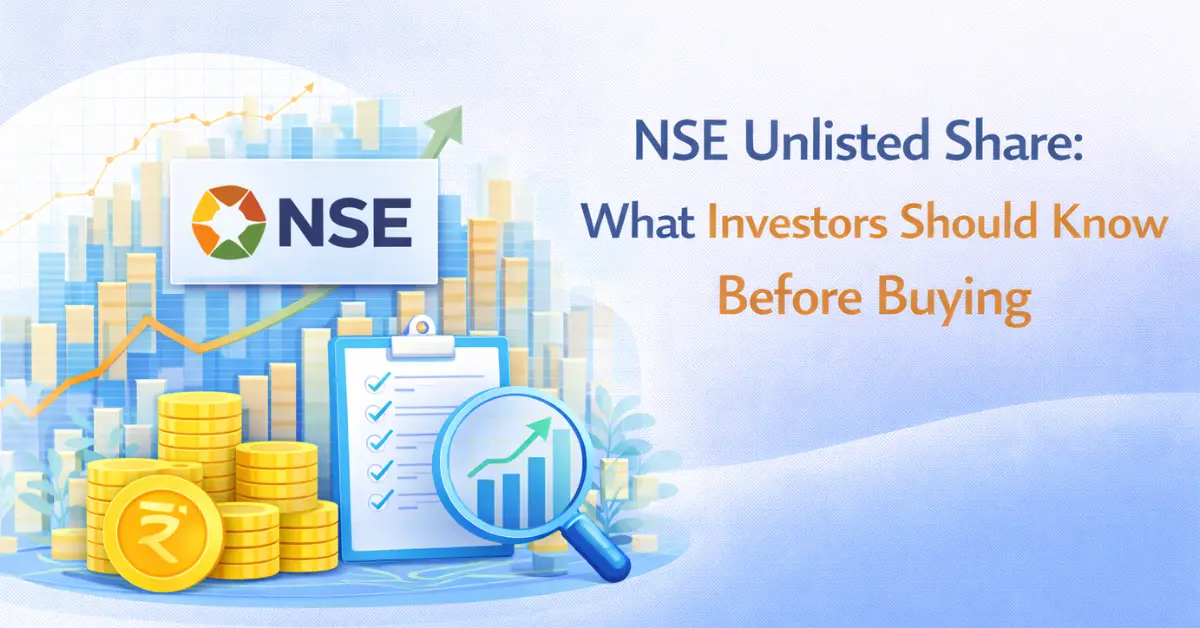
The National Stock Exchange (NSE) is the biggest stock exchange in India, facilitates all the trades in the Nifty 50, and is the biggest player in the derivatives market worldwide. However, NSE is not yet listed on any stock exchange. NSE shares are offered in the unlisted pre-IPO market, and after receiving SEBI’s NOC, the NSE will conduct an IPO in 2026. This is a comprehensive guide on NSE Unlisted Shares, including the current NSE unlisted share price, how to purchase NSE unlisted shares, NSE unlisted share bonuses and dividends, target prices for NSE unlisted shares in 2025 and 2030, and the associated taxes.
Investors who want to explore other available options and buy and sell unlisted shares, visit DelistedStocks.
Table of Contents
- What is NSE?
- What Are NSE Unlisted Shares?
- NSE Unlisted Share Price Today
- NSE Unlisted Share Price Target 2025 and 2030
- NSE Unlisted Share Bonus — What Happened?
- NSE Unlisted Share Dividend — Does NSE Pay Dividends?
- How to Buy NSE Unlisted Shares Online
- Is It Safe to Buy NSE Unlisted Shares?
- NSE IPO — When Will NSE List on the Stock Market?
- Frequently Asked Questions
What is the National Stock Exchange (NSE)?
NSE is short for the National Stock Exchange of India. It is the largest stock exchange in India. If you are trading shares of companies like Reliance, TCS, or Infosys through your broker app, your transaction is likely to be processed through NSE. NSE began operations in 1994, but it was established in 1992. Stock trading in India before the NSE was slow and manual. It was also not easily accessible to average investors. This all changed with NSE by introducing the first fully computerised trading system in India. NSE is not only the largest exchange in India, but it is also one of the largest in the world in terms of the number of trades conducted in a day. The National Stock Exchange (NSE) also owns the Nifty 50 index, which shows how the top 50 Indian companies are doing on the stock market. When a news source says, “Nifty went up today,” they are referring to the NSE.
What are NSE Unlisted Shares?
This gets interesting. NSE, the operator of the stock exchange, is itself unlisted. This means you cannot trade NSE’s shares on any stock trading applications such as Zerodha, Groww, or Upstox. Nonetheless, NSE’s unlisted shares are real and are held by early backers, institutions, and employees. Some of these shareholders are open to trading their shares privately. This practice of trading unlisted shares is called the unlisted share market or the pre-IPO market. So, NSE unlisted shares mean buying an ownership stake in NSE before the company lists on the stock market. For example, buying NSE unlisted shares today is like buying MSEI unlisted shares before the stock exchange goes public. To understand the early-stage market for IPOs, you can visit DelistedStocks to see all available unlisted shares in India.
NSE Unlisted Share Price Today
NSE unlisted shares have a market value, but it isn’t as constant as the market value of listed shares. The value changes continuously based on the number of buyers and sellers in the market, which is a concept called supply and demand. Since unlisted shares are not listed on any exchange, you cannot see any listed prices on an exchange. However, platforms like Delisted Stocks list unlisted shares, and you can see the prices for buying and selling as well as gain information regarding the number of buyers and sellers in the market.
When it comes to NSE unlisted shares, there are some specific things you should know regarding the prices:
- Prices are listed in terms of buy and sell prices. The buy price is the price you pay to purchase the shares, and the sell price is the price you receive for selling the shares. The buy and sell prices are usually not the same.
- When you purchase unlisted shares, you are required to buy a minimum of 250 shares. This is called one lot.
- Positive company news and financial results tend to increase the share prices. Likewise, negative market news and financial results diminish the value of stocks.
- Another sort of analysis of the historical pricing behavior of NSE unlisted shares is through the analysis of unlisted NSE share prices.
NSE Unlisted Share Price Target 2025 and 2030
Several investors ask, what is the NSE unlisted share price going to be in 2025, or 2030?
It’s a fair question, but, to be honest, predicting stock prices is not an exact science. It’s impossible for people to predict a precise price for a share, whether it’s listed or unlisted. Anyone who has provided or will provide an overly specific and overly confident price target is simply making an educated guess.
In this example, most investors look at the case like this:
- For 2025: The expected unlisted market price hinges on whether the NSE has submitted an IPO (or a DRHP) to SEBI. If an IPO is underway, the unlisted market price is expected to rise with the influx of new market participants.
- For 2030: Assuming NSE goes public by then and diversifies into options trading, data, tech, and fintech, then investors holding unlisted shares as of now will see compensation for their patience in 5 to 7 years.
Risk is an integral part of investing, and with unlisted stocks, the risk is higher compared to listed stocks. But NSE has a good grip over India’s derivatives market, and that is a profitable and debt-free business.
NSE Unlisted Share Bonus: What Happened?
To put it simply, a bonus share is a share that the company gives you for free.
NSE has issued a 4:1 bonus, which means that for every share you own, you get 4 new shares completely free. Thus, if you had 100 shares prior to the bonus, you now own 500 shares.
Bonus shares mean the valuation of each share decreases because there are now more shares when looking at the whole value of the company.
Imagine a pizza; if the same amount of pizza is cut into a larger number of slices, there are more slices available, but the amount of pizza has not increased.
Because of the bonus, the stock was more marketable, and the bonus gave a positive sentiment towards NSE because when a company issues a bonus, management is usually optimistic.
Before the announcement, holders of NSE unlisted shares were highly anticipating the bonus share announcement. They received more shares, and therefore, more shares to receive dividends in the future, but because of this, the value of the shares did not change.
NSE Unlisted Share Dividend: Does NSE Pay Dividends?
Dividends do get paid out to shareholders of NSE, which is why NSE unlisted shares are more enticing than other pre-IPO investments, even though NSE is unlisted. A company’s earnings are divided among shareholders in the form of dividends. Unlike an interest payment from a bank, which comes from the bank’s assets, a dividend payment derives from a company’s profit. Year after year, NSE has increased its dividend yield as a reflection of its growing profitability. That’s an indicator that NSE is a sound company, and not just a good company on paper.
What does this mean to a prospective buyer of NSE unlisted shares?
For prospective purchasers of unlisted shares:
- You earn dividends during the waiting period for an IPO.
- Dividend payments are a testament to NSE’s favorable financial stance.
- An increase in dividends reinforces the belief in a company’s good performance.
- Dividends earned from unlisted shares are taxed as income, which is subject to income tax slabs.
How to Buy NSE Unlisted Shares Online
Buying NSE unlisted shares is easier than you think. Due to a new system that came into effect in 2023, purchasing shares can be completed in a few minutes.
An outline of the procedure is provided below for clarification.
Step 1. Choose a trustworthy source
Visit DelistedStocks to find the current price of NSE unlisted shares. If the price seems reasonable to you, continue.
Step 2. State the number of shares
You are allowed to purchase a minimum lot, based on your financial ability, and decide how many lots you wish to purchase.
Step 3. Submit Basic Documents
You must submit:
- CML (Client Master List) – this is a document provided by your broker and contains your demat account information
- PAN Card
- Cancel Cheque
- Aadhaar Card
Step 4.Process your Payment
Once payment details have been confirmed by the recipient, payment can be executed through NEFT, RTGS, or UPI. Payments are not to be made in cash and without payment detail confirmation to the recipient.
Step 5. Shares will be credited to your Demat Account
Shares will be credited to your demat account 1 to 3 business days after payment has been confirmed. This can be checked through the NSDL or CDSL account by searching the ISIN number INE721I01024, or CDLS INE721I01024. The ISIN number is a unique share identification number for shares listed on the NSE. No more lengthy waiting periods and complicated document requirements.
Is Buying NSE Unlisted Shares a Safe Investment?
This is a fundamental question, and we will provide you with the right response. NSE is a strong business. It is profitable and debt-free. It occupies a strong position in the Indian financial markets. NSE pays dividends and has a good balance sheet. This will be further bolstered with the upcoming IPO.
However, understanding of the realistic risks is imperative to proceed:
- The IPO could be delayed.
- The IPO may price lower than the unlisted price.
- You can’t sell the shares easily. Unlisted shares cannot be sold on the exchange at will like listed shares.
NSE unlisted shares are appropriate for those willing to commit funds they will not need for a period of 2 to 3 years, can live with some risk, and understand that this is a higher risk, higher potential reward investment than a standard fixed deposit or mutual fund.
NSE IPO: What is the NSE Listing Date?
The NSE IPO is one of the most awaited events in the Indian capital market. Here is a simple explanation of the current status:
What is an IPO?
An IPO or Initial Public Offering is the event of a private company offering its shares for the first time by listing them on a public stock exchange. After the IPO, anyone can trade NSE shares through a broker app, just like any other listed company.
What are the reasons for the delay in the NSE IPO?
NSE had its IPO in the pipeline for several years. The delay was mainly on account of regulatory probes, most significantly, one pertaining to its co-location servers, where some traders allegedly had priority access to the exchange.
This extended litigation stalled SEBI’s approval for the IPO.
What is the current status?
SEBI has issued its first green light to the NSE’s IPO by granting its NOC. NSE is now preparing to appoint the investment banks and to draft the DRHP (Draft Red Herring Prospectus), which is the official IPO prospectus to be filed with SEBI.
What follows the IPO?
Investors in the unlisted market purchases of NSE shares will be subject to a six-month lock-in period post IPO listing. Consequently, these investors will not be able to sell their shares immediately post-listing; rather, they will have to wait six months before they can trade these shares on the exchange. For a comprehensive analysis of NSE’s position in the hierarchy of exchanges in India, see our analysis on NSE dominance in the unlisted share market 2026. Additionally, you can analyze NSE unlisted shares vs MSEI unlisted shares for a more informed perspective, or explore MSEI unlisted shares as a potential investment opportunity in the exchange segment.
FAQ’S
Q1- What are NSE unlisted shares?
Q2- What is the NSE unlisted share price today?
Q3- Can retail investors buy NSE unlisted shares?
Q4- What is the minimum lot size for buying NSE unlisted shares?
Q5- Does NSE give dividends on unlisted shares?
Q6- What was the NSE bonus share announcement?
Q7- When will the NSE IPO happen?
Q8- Is it safe to invest in NSE unlisted shares?
Q9- How are NSE unlisted shares transferred to investors?
Q10- What are the risks of investing in NSE unlisted shares?
Q11- How can investors buy NSE unlisted shares online?
Q12- Are NSE unlisted shares taxable?
Disclaimer
This article is for informational purposes only and should not be considered investment advice. Prices and data of unlisted shares are based on publicly available sources and may vary. Investors are advised to conduct independent research or consult financial professionals before making investment decisions.