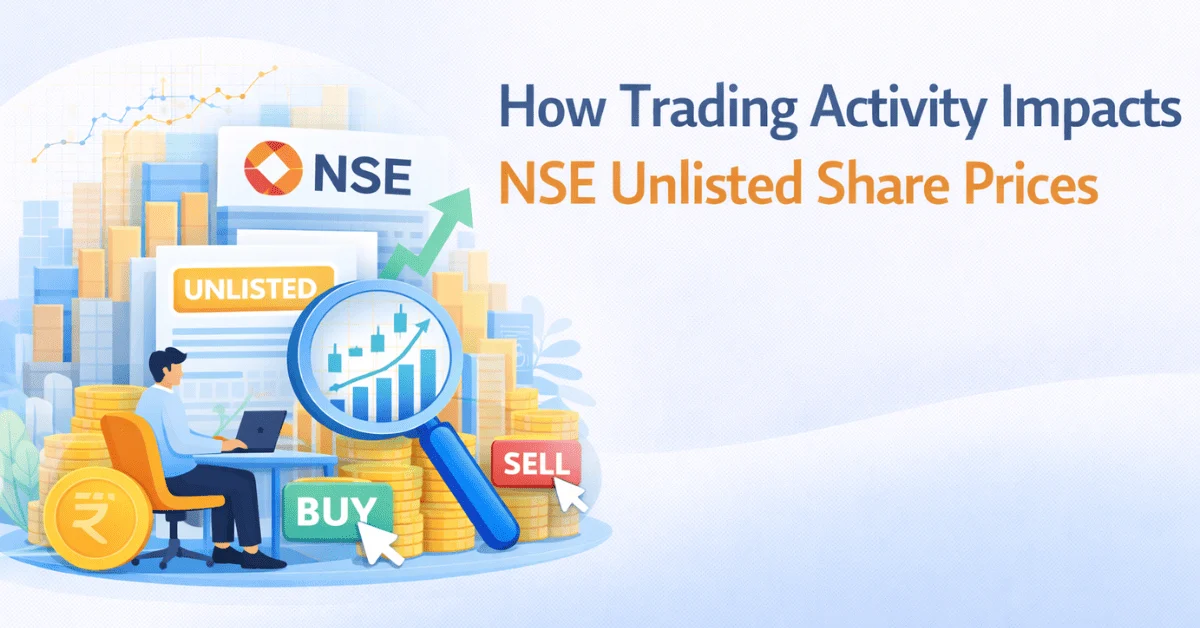
Most investors don’t realize that when trading volumes go up for some companies, it’s not only the share prices for the stocks in their trading apps that gets impacted, but also the prices of NSE (National Stock Exchange) unlisted shares. Think of a mall with a lot of activity: the big department stores, the little specialty shops, and even the little kiosks. Just like that, when there’s a lot of trading on the NSE, the NSE unlisted share price will be impacted positively. This is a guide that will show how trading activity positively impacts unlisted shares prices of the NSE, and trading volumes of the NSE itself. It’s a relationship that you’re probably familiar with but will help immensely to understand market efficiency. Before you go on, the unlisted shares are just the equity shares of companies that are not listed in the regular stock exchanges and, as a result, are traded privately between the buyers and the sellers.
What are the NSE Unlisted Shares?
Before we analyze how trading activity positively impacts prices of the NSE, let’s digest what it is we are talking about. NSE unlisted shares mean equity shares of the National Stock Exchange of India. NSE is the same where you buy and sell shares of big names like Reliance, TCS, etc.; however, NSE unlisted shares are not listed on any public exchange.
Key Points:
- NSE is the largest stock exchange in India in terms of trading volume.
- Shares of NSE are traded secretly (off-market).
- Demand and supply, not daily exchange prices, determine the price of shares.
- NSE unlisted shares price fluctuates based on prevailing market conditions.
Curious about how stock exchanges function in India and why NSE is of utmost importance? This explains why unlisted shares are demanded after by investors.
What Do We Mean by “Trading Activity”?
Let us break it down, it is vital to our discussion.
Stock market trading activity means how busy the market is and includes:
- Daily trading volumes — number of shares traded
- Number of participants — retail investors, institutions, traders
- Derivatives activity — trading in futures and options
- Market liquidity — how quickly money comes and goes
- Frequency — how often trades occur
High numbers indicate a market that is “active” or in a “bull phase” while low numbers indicate a “quiet” market or a “bear phase”.
Interesting: The activity level impacts the price movements of unlisted shares on the NSE. The Importance of Trading Activity for NSE Unlisted Share Prices
1. More Trading = More Revenue for NSE
What’s the biggest impact? The NSE makes money with every trade on the market.
With greater trading volumes:
- The NSE processes a greater number of trades.
- The revenue collected from transaction fees rises.
- The profit margin increases.
- The business position improves.
When investors see the NSE trading volumes increasing, they see the business as financially healthy, increasing interest in the unlisted shares of the NSE and consequently increasing the price. Let’s say you owned stock in a tollway and suddenly traffic doubled overnight. Because you would make more money from tolls, your stock becomes more valuable. NSE works this way too!
2. Market Visibility Increases During Active Phases
Now this is something powerful, yet subtle.
When trading is very active:
- News channels display NSE data
- NSE is in the headlines saying “NSE crosses X trading volume”
- Social media is buzzing and talking
- NSE is trending
All this NSE visibility means more people know about it. Then people start asking “Can I invest in NSE”? “What is NSE unlisted shares price?” All this visibility means more people want NSE unlisted shares and prices increase. You can check the NSE unlisted share page to check current prices, trends, and forecasts.
3. Market Liquidity Also Affects Unlisted Shares
Now, this is where it gets very interesting, liquidity means “the amount of cash available that can be used for investments.” In active trading periods, liquidity flows in several ways:
● Increased cash availability for investment in the stock market.
● Investment interest shifts to stocks, including non-listed ones.
● Investment interest moves to non-listed stocks.
Analogy: Think of liquidity like the water in a river. When river water is high, it pours to smaller river streams. Similarly, when river water is high, the market invests in shares including unlisted shares of NSE.
Increased liquidity means:
● Increased buyers of unlisted shares of NSE.
● Increased ease of transactions.
● Increased ease of price transactions.
● Increased price of unlisted shares of NSE.
● Increased number of transactions.
● Increased number of unlisted shares of NSE.
● Increased number of buyers.
● Increased number of ease of transactions.
4. Positive Sentiment Creates Upward Price Momentum.
Now, let’s look at Psychology as a Market Driver. People drive the market and people have emotions.
When trading becomes more common and the market trends upwards:
• More investors start to believe in the bullish market.
• More people will begin to feel positive and believe in the growing economy.
• More positive traders will adopt a bullish sentiment.
• More traders shift to a long-term approach.
All of these factors positively affect the NSE unlisted shares because traders start believing in the positive potential of India’s growing capital market and its unlisted shares, as the market is the backbone of this growth.
This positive belief creates a positive feeling towards investing in unlisted shares of NSE unlisted shares, as once a belief in economic growth has been created, the positive feeling will be difficult to stop.
How Derivatives Trading Specifically Impacts NSE Prices
Most people are shocked to learn that NSE is the largest exchange for derivatives in the world, and as a result, the largest in the number of contracts traded. The derivatives market, specifically, the futures and options market, creates a lot of trading volume for the NSE which in turn creates a number of positive impacts for the exchange. Such as increased relevancy as a market infrastructure, potential for increased derivative trading fees, improved technology, and increased global reputation. All these create a positive impact for the unlisted shares of NSE and how investors view the shares.
Supply and Demand Dynamics in the Unlisted share Market
Unlike the listed stock market where the prices of stocks change every second, the prices of unlisted shares are determined in a different way. NSE unlisted share prices are shaped by two primary components: supply and demand.
Supply Side (Sellers):
- Current shareholders who are willing to sell
- Quantity available to sell
- Seller’s expectations and price target attention
Demand Side (Buyers):
- The number of buyers interested
- Available capital to deploy
- Current prices willing to be paid
Price changes caused by NSE unlisted shares and traded activity levels follow a pattern.
High trading activity:
- An increase in demand occurs, as more buyers want NSE shares.
- A supply limit remains as current holders don’t want to sell
- Prices increase as demand outweighs supply.
Low trading activity:
- A decrease in demand occurs as buyers lose interest.
- An increase in supply occurs as some holders want to exit.
- Prices stabilize or decrease as the market loses its value of demand.
This is why unlisted share prices at NSE show an easy relation to overall trading activity in the market.
The Role of Market Participation Growth
The role of market participation in this is another important element. Active trading markets attract new participants in investing by:
- Increasing the number of first-time demat account openings.
- Shifting retail impliable investors to active traders.
- Increasing institutional participation.
- Deepening overall market penetration.
Active market participants improve their understanding of:
- How exchanges operate.
- How to access other investment opportunities like unlisted shares.
- How to use NSE for investment.
- How to buy unlisted shares.
Instead of buying unlisted shares from NSE, market participants also buy MSEI unlisted shares that provide opportunities to invest in the unlisted shares of the companies similar to the NSE unlisted shares.
Media Coverage Amplifies the Effect
In highly active trading periods, financial news media provide:
- 24-hour market update broadcasts
- Display NSE trading data on every news ticker
- Offer detailed market reports in their newspapers
- Engage in trading volume record discussions on social media
This type of media coverage in highly active trading periods creates a WIN-WIN effect
Active Trading → More Media Coverage → NSE Data Visibility → Increased Interest → Increased Demand → Increased Prices of NSE Unlisted Shares
This is a reinforcing cycle where each element strengthens the others.
Price Discovery: How It Works Without Exchange Screens
In regular stock markets:
- Prices change immediately based on buy/sell orders.
- Everyone sees the same price.
- Order books are visible.
- Trading continues until the market closes.
In unlisted markets:
- Price is negotiated between the buyer and the seller.
- different prices, different platforms.
- There is no continuous order book.
- A transaction occurs when both parties agree.
However, during active trading phases, price discovery becomes more efficient because:
- more transactions create more reference points
- buyers and sellers improve their information
- negotiation gaps narrow
- prices match the market’s
- reality quicker
Would you like to know the steps for buying and transferring unlisted shares? Understanding the steps gives you confidence to operate in the unlisted market.
Comparing Active vs. Quiet Market Periods
We will analyze how the movement of the NSE unlisted shares varies with the market.
Active Market Period:
- Strong Demand For NSE Unlisted Shares.
- Price Discovery Happens Instantly.
- There Are Multiple Buyers.
- There Are Multiple Sellers.
- There Admin Lies Pricing Control.
- There Are Multiple Transactions.
- Price Is Pulled Up.
Quiet Market Period:
- There Is Weak Demand For NSE Unlisted Shares.
- Price Discovery Is Dragging.
- There Are Few Buyers.
- There Buyers Have Pricing Control.
- There Are Few Transactions.
This cyclical pattern explains why monitoring the trading activity for NSE unlisted shares is helpful to analyze the trends in the movement of the price of NSE unlisted shares.
The Psychological Factors Driving Price Changes
While the movement of markets is primarily based on money, the movement of money is based on psychology.
The following are the components of this movement:
1. Confidence Bias
Active and rising stock markets boost confidence in investors. Periods of market confidence may lead investors to bear the cost of the price increase in anticipation of subsequent growth.
2. Visibility Effect.
Things that are visible on a continuous basis and in high volume are considered more valuable. During active trading, NSE is in the news, on trading apps, and in conversations. The more people see it, the more valuable they think it is.
3. Momentum Mentality
Winners attract more players. As NSE unlisted share prices begin to rise, more buy-in, creating a rush to buy.
4. Fear of Missing Out (FOMO)
People are more likely to buy NSE unlisted shares as FOMO drives demand. Recognizing these behaviors will assist with understanding the NSE unlisted shares prices, rather than the prices as mere statistics.
Does High Trading Activity Guarantee Price Increases?
To be clear, a connection does not mean a cause.
There are reasons why trading activity does not guarantee increases, even though it may influence NSE unlisted shares prices.
Reasons Supporting Price Inflation
- More trading volume increases NSE income.
- More demand with improved liquidity.
- More positive sentiment to buy.
- More buyers due to improved visibility.
Reasons Limiting Price Inflation
- Changes to regulation of the exchange.
- Increased competition from other exchanges.
- Uncertainty due to the economy.
- large holders of an asset selling.
- high prices.
- Valuation concerns.
There is a strong, but not absolute, connection between trading activity and the prices of shares in NSE unlisted shares. Smart investors will find more.
Why Understanding This Connection Matters
When it comes to NSE unlisted shares or any investment, knowing the connection to trading activity is important because:
- You understand the reason behind price changes.
- You can decide the best time to invest as active markets mean high prices.
- You learn how to seek price behavioral patterns.
- You understand and can anticipate demand through volumes.
- You understand the reasons and can make better investment decisions.
Trading activity insight and analyst demand can be understood through the comprehensive market infrastructure resources by Delisted Stocks and other investment avenues.
Important Things to Consider
What you can track as price change are:
- Metrics to track per exchange.
- Daily trading volumes (NSE) in cash and derivatives.
- Daily active traders/investors.
- Market breadth (total number of shares active in trading).
- Daily active traders/investors.
- Daily active traders/investors.
- Market volatility.
Market Participation:
- Total Demat accounts in the market.
- Retail Participation.
- Institutional Participation.
- Market Sentiment.
Unlisted Market Activity:
- NSE trading frequency
- Bid-ask spread
- Buyer inquiries
- Recent sales
These metrics and their activities give direction to the anticipated prices of NSE unlisted shares.The Big Picture: India’s Growth Story and the NSE To analyze the NSE unlisted share price movement, one needs to consider the fundamental aspects of the company.
NSE is integral to the economy’s growth as it facilitates:
Capital formation.
- Investment opportunities for millions.
- Job creation across the spectrum of the financial ecosystem.
- Positioning of the country in the global markets.
- Financial inclusion and literacy.
Increased trading activity indicates:
- Growth in the economy.
- Greater confidence in business.
- Increased participation from investors.
- Increased maturity of the market.
This all contributes to the long term value of the NSE and that is why we see a correlation between the increased trading activity and the higher demand for the NSE unlisted shares. To better understand the value of trading and the regulatory framework of stock exchanges, it is important to understand the ecosystem regulation.
Final thoughts: Trading Activities and NSE Share Prices Correlate
The relationship between market trading activity and NSE unlisted share price movement is evident and clear:
More trading activity = More NSE revenue = More trading activity = More trading activity = Increased liquidity = Increased demand = Increased price.
This is not guess work, it is a phenomenon that is explained by the demand and supply, psychology of the investors, and market mechanics. For investors and market watchers, there is a direct connection, and it aids in comprehending the reason behind price fluctuations, as well as, the overall market directions. If you are looking to make an investment, or want to familiarize yourself with market activity, it is important to understand the proximity of trading activity to NSE unlisted share prices to understand the market in detail. Take an informed approach, understand the indicators, and conduct research before making decisions based on price movements and market activity. For this investors can visit Delisted Stocks.
FAQ’s
Q1-What mainly drives NSE unlisted share price movement during active market phases?
Q2- Does higher trading activity directly increase NSE unlisted share prices?
Q3- How does market liquidity impact NSE unlisted share price movement?
Q4-Is NSE unlisted share price movement connected to derivatives market activity?
Q5-How is price discovery handled for NSE unlisted shares?
Q6-Does strong market performance guarantee higher NSE unlisted share prices?
Q7-What indicators help track NSE unlisted share price movement effectively?
Disclaimer
This article is for informational purposes only and should not be considered investment advice. Prices and data of unlisted shares are based on publicly available sources and may vary. Investors are advised to conduct independent research or consult financial professionals before making investment decisions.